4 Interaction and Interpretability in OpenTI
The preceding section examined how systems orchestrate functional capabilities to derive insight realizations from tabular corpora. Yet the quality of any realization ultimately also depends on how accurately the system interprets what the user, be that a person or an agent, seeks in the first place. This section shifts the focus from the mechanics of insight extraction to the interface between users and systems, examining how insight needs are communicated, interpreted, and refined through interaction. Compared to other sections in this paper, the discussion here is more conceptual and draws extensively on adjacent work in human-computer interaction and information retrieval beyond the systems and benchmarks reviewed in Sections 3 and 5.
Requiring users to fully specify all choices involved in selecting data (), defining the analytical methodology (), and presenting results () is both impractical and often impossible. Complex insight needs entail numerous interdependent choices that users cannot reasonably enumerate upfront, and doing so would place a prohibitive burden on interactions. More fundamentally, insight needs are inherently latent, as established in Section 2.1.2. The expressed need is a compromised formulation of the latent need , shaped by what users can articulate and believe the system can accommodate . The system consequently never has direct access to , and can only construct an approximation from the expressed input and available contextual information.
The fundamental challenge of designing user-system interactions is thus aligning the system’s representation of the insight need with the user’s latent insight need . How well this gap can be closed depends on the mechanisms for interpreting and specifying inputs available to systems and their users. Instead of demanding exhaustive specification of the insight need , OpenTI systems should treat users as cooperative communicators and interpret their inputs accordingly.
Grice posits that participants in cooperative communication provide sufficient but not excessive information (maxim of quantity) while remaining truthful (maxim of quality). In the context of insight extraction, this implies that users are intentional about which aspects of their insight needs they specify explicitly and which they leave implicit. When a user asks “What is the development of global renewable energy installations since 2010?”, they specify the core semantic concepts but leave the exact data to retrieve, the methodological implementation, and the output format unspecified. This underspecification is not necessarily a failure of articulation but can be interpreted as a delegation of authority , where the user relies on the system to infer reasonable interpretations for unspecified components, and the system accepts this delegation as its contribution to the grounding process.
Extending the argument of Gomm et al. , whether and how a system can resolve a given instance of underspecification depends on the character of that instance. We propose to distinguish three ways of resolving underspecification, illustrated along the running example of a user asking “What is the average income in Paris?”:
- Conventional resolution. Where strong conventions or domain defaults exist, the system can resolve unspecified aspects autonomously by assuming the most reasonable interpretation. The entity “Paris” is conventionally interpreted as the capital of France rather than any of the towns bearing the same name in the US or elsewhere, and the system can proceed on this basis, potentially disclosing the interpretation to the user.
- Selective resolution. Where the expressed need admits multiple valid realizations but the user has expressed no preference among them, the system may exercise agency in selecting one. In the same example, the boundaries of Paris are not uniquely determined by the input, as the city of Paris proper, the greater Paris metropolitan area, and the Île-de-France region are all defensible interpretations. The system may select one based on what data is available or what is most commonly intended, but such choices must be disclosed, since users cannot otherwise judge whether the resulting realization reflects their intent and may mistake a contingent analytical decision for an objective finding.
- User engagement. Where neither convention nor reasonable selection is applicable, the system must engage the user directly. This can take one of two forms. First, straightforward underspecification, where the user has not provided enough information to differentiate valid from invalid realizations. A user asking “What is the average income?” without any geographic or demographic boundary illustrates this, as there exists no convention to select a default scope, no principled set of alternatives can be derived from the input alone, and the system must elicit the missing specification before proceeding. Second, unresolvable underspecification, where the user cannot specify because they do not know the methodological possibilities of the system or the data it has access to. In this case, no clarifying question can be meaningfully answered until the system first makes something about its data and capabilities visible to the user.
This distinction parallels the obligations of user revealment and system revealment formulated by Radlinski and Craswell , applied to OpenTI systems. User revealment requires the system to actively support users in articulating and refining their insight need over the course of interaction, through mechanisms that elicit, disambiguate, and extend the expressed need. System revealment requires the system to continuously make its data coverage, analytical capabilities, and the choices it has made sufficiently transparent that users can form accurate expectations, update their inputs, and assess whether the system’s contributions meet the grounding criterion. System revealment is not a one-time disclosure at the start of an interaction but an ongoing obligation that runs throughout the analytical process, as the system retrieves data, selects methods, and constructs realizations whose basis the user cannot otherwise inspect.
The extent to which conventional and selective resolution can align with depends on the contextual knowledge the system can draw on when interpreting . Systems that do not adapt to specific users are limited to population-level conventions. Yet users bring distinct expertise, roles, and analytical perspectives , and they create a shared context with the system through continued interactions, where prior interactions serve as context for subsequent ones , so the same expressed need may warrant different interpretations and realizations depending on who expresses it and in what context. Personalization aims to address this by conditioning interpretation on contextual information such as user profiles and interaction histories, a mechanism with a long tradition in information retrieval that has more recently been applied to conditioning language model outputs on retrieved user context . The mechanisms for contextualization reviewed in Section 3.3.1 partially address this conditioning, yet they ground interpretation exclusively in the domain, the corpus, and prior interactions within a session, whereas persistent adaptation to the individual user remains unexplored in the reviewed systems. Successful contextualization enables autonomous resolution of inputs that would otherwise require user engagement, reducing the interaction burden. At the same time, adaptation that is neither visible nor controllable risks resolutions that are misaligned in ways users cannot detect , extending the disclosure obligations of system revealment to personalized interpretations.
This section explores the mechanisms through which user-system interactions support this dynamic. We characterize user-system interactions in OpenTI along the interaction mode (Section 4.1), which governs when and by whom input is provided during the insight extraction process, and the interaction means (Section 4.2), which describe the mechanisms through which input is conveyed. Together, interaction modes and means shape how insight needs are communicated, refined, and aligned between users and systems to enable appropriate realizations. Beyond these mechanisms, Section 4.3 examines interpretability, required for users to verify the system’s analytical derivations.
4.1 Interaction Modes
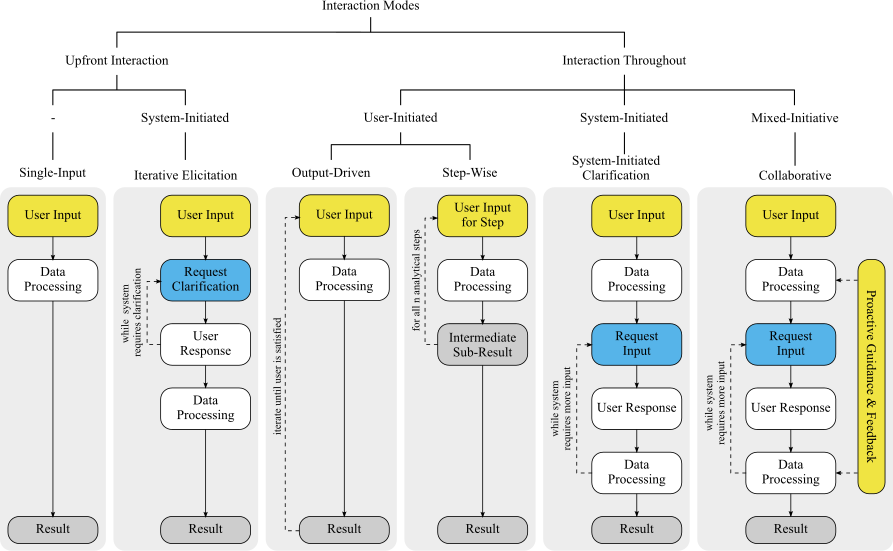
Interaction modes organized by interaction timing, whether input occurs only upfront or continues during execution, and interaction initiative. Counts state how many of the 58 reviewed systems and 42 benchmarks support the respective mode. Counts are not mutually exclusive; 7 systems and 7 benchmarks support more than one mode.
Interaction modes define the control flow between user and system throughout the insight extraction process. As illustrated in Figure 8, we propose distinguishing interaction modes by interaction timing, differentiating whether user input occurs solely before data processing begins or continues throughout, and by the interaction initiative, differentiating whether the system or the user takes the lead in steering the insight extraction and alignment with the user’s intent. The initiative dimension draws on the spectrum of mixed-initiative interaction established by Allen , ranging from purely user-led interactions through increasing degrees of system involvement to fully negotiated interactions in which neither party has a fixed role and both take active roles in steering the interaction. The timing dimension distinguishes modes in which user-system interaction is confined to an upfront stage before the system performs any data processing, from those in which interactions unfold throughout the execution, which is particularly relevant in OpenTI settings where users cannot anticipate the data and analytical choices the system will confront during processing .
Most systems (Section 3) and benchmarks (Section 5) assume input occurs solely before processing. The simplest case is single-input interaction, shown as the left-most mode in Figure 8, where a single user input triggers the full extraction process without intermediate exchange, corresponding to purely user-initiative interaction. This mode minimizes user involvement and relies entirely on conventional and selective resolution to derive , but provides no mechanism to resolve remaining underspecifications or adapt to data particularities that users are not aware of, resulting in the propagation of misalignments into the final output. This places a high burden on the initial input to provide sufficient specification , which may be particularly challenging the more complex the required analysis . Iterative elicitation (second from the left in Figure 8) extends single-input by engaging users in pre-processing dialogue to refine before data binding or analysis begins, mirroring commercial1 and academic “deep research” systems that ask clarifying questions to stabilize intent. This can surface and correct misconceptions before committing computational resources, but adds interaction overhead before users see any results and cannot address ambiguities arising from data selection or corpus-specific particularities encountered during execution.
While only taking input upfront minimizes user interactions, it does not enable users to react to and steer the insight extraction process, requiring them to be highly aware of and capable of expressing their insight need with sufficient specification. In contrast, integrating user input throughout processing enables reactive steering based on intermediate results, at the cost of increasing the interaction complexity. This provides users with the opportunity to disambiguate, verify intermediate results , contribute domain knowledge, specify latent preferences, or intervene on critical decisions . The simplest such extension is output-driven interaction (third from the left in Figure 8), where users observe system outputs and provide refinements, triggering iterative cycles until the realization satisfies their need . This allows users to recognize retroactively when their initial specification led to misaligned realizations, correcting poor selective specification by the system as it becomes apparent upon seeing concrete results. Yet, achieving a satisfactory realization may require many iterations if the initial diverges significantly from , and requires full processing to complete before feedback can be incorporated. Step-wise interaction , shown as fourth from the left in Figure 8, grants finer control by having users provide instructions step-by-step, directly specifying individual analytical steps rather than the complete, potentially high-level, insight need upfront. This is still a user-initiative interaction, but applied at the granularity of individual operations rather than the full extraction task. It suits more exploratory needs where emerges for users through data engagement , but shifts the orchestration burden to the user, requiring greater analytical expertise and end-to-end planning.
In system-initiated clarification (second from the right in Figure 8), initiative shifts to the system, which solicits user input when encountering low-confidence decisions or missing information required to resolve , that is, when selective resolution has low confidence or when information is genuinely missing. Rather than proceeding with uncertain interpretations, the system explicitly engages the user to resolve ambiguities, operationalizing the cooperative principle by exercising agency where it can while deferring when alignment is uncertain . This, however, requires a system that reliably estimates its uncertainty and may interrupt user workflows at unpredictable points. Collaborative interaction (right-most in Figure 8) generalizes this to a bidirectional exchange throughout processing . The system requests clarification while users can also intervene proactively, observing operations and providing guidance without explicit solicitation . This flexibility lets collaborative interaction address all three resolution challenges bidirectionally, but introduces implementation complexity and may overwhelm users unfamiliar with the analytical process. System-initiated and collaborative modes are only emerging for OpenTI, building on established mixed-initiative principles from HCI research .
These modes are not discrete alternatives but form a continuum, and aspects of different modes may be combined, for instance by applying step-wise control with iterative refinement at each step. The appropriate mode depends on user expertise and the complexity and requirements of the analytical task . Empirical evidence from information retrieval suggests that the degree to which an insight need is directed elicits measurably different interaction behaviors . Needs that are less directed at the start, which iteratively become more concrete through engagement with data , require sustained interaction throughout processing and tend to be poorly served by upfront specification modes, whereas needs that are more concrete and directed from the start place lower demands on continued interaction. Overall, interaction modes should accurately approximate the insight need while minimizing the burden placed on the user .
The interaction modes described above assume the system commits to a single realization at each step, with iteration correcting misalignments between and the user’s latent . An alternative, compatible with several of the modes above, is for the system to surface multiple candidate realizations simultaneously , making selective resolution explicit by presenting users with the space of valid alternatives rather than having the system choose implicitly. Saparina and Lapata generate multiple natural language interpretations of ambiguous queries before parsing, allowing users to select among semantically distinct readings. Similarly, multiverse analysis interfaces present multiple valid analytical paths arising from defensible methodological choices, enabling users to evaluate how results vary across reasonable alternatives. These approaches are particularly relevant in upfront specification modes where post-processing iteration is limited, making selective resolution explicit and preserving user agency over choices that would otherwise be delegated to the system. However, presenting too many alternatives risks overwhelming users, while too few may miss valid interpretations . Balancing comprehensiveness with cognitive manageability remains an open design challenge.
4.2 Interaction Means
Orthogonal to the interaction mode, the means of interaction describe the mechanisms by which users provide input. Human-computer interaction research has established a progression of interaction styles, from command languages and form-filling through menu selection to direct manipulation , each trading expressiveness against the guidance it provides to users. This is especially relevant in OpenTI where users express analytical intent over data whose vocabulary and structure they may not know.
Natural language text constitutes the dominant interaction means in current systems and benchmarks, reflecting the broader emergence of conversational interfaces following the proliferation of chatbots. Text aligns naturally with open-ended insight needs, accommodating varied user goals without requiring familiarity with system-specific syntax. However, natural language is also well-documented as an ambiguous medium for data interaction , where unconstrained text provides no guidance about what information the system requires , leaving users unaware of what they must specify to avoid unresolvable underspecification. Complementary interaction means address these limitations by scaffolding specification to make the space of choices explicit, and by enabling direct manipulation at appropriate abstraction levels to correct misaligned resolutions as they emerge.
Specification Interfaces.
Specification interfaces impose a structure on the input channel so that users are guided towards providing the relevant information the system requires, adding a layer of guidance beyond free-text interaction. They address users’ knowledge gap about what information the system expects by directing input into categories that signal what must be specified, something a blank text box does not do and that has been observed to slow users down and lead to underspecified requests . They can also surface valid options among which users can select rather than delegating decisions to systems.
Specification interfaces can be organized around the components of the insight need . To target the data need , specification interfaces may prompt for temporal scope, entity types, or domain boundaries, using the selected values to constrain retrieval over the corpus. For the methodological need , specification interfaces can enumerate the options for analytical operations or modeling choices, freeing users from having to articulate the corresponding terminology. For the output need , interfaces may expose modality choices such as tables, charts, or textual summaries, making the form of presentation a user-controlled rather than system-assumed dimension. Guo et al. provide an empirical demonstration of this decomposition, with a prototype that separates fields for dataset descriptions, domain knowledge injection, and selection among system-generated execution plans, finding that users benefit from this explicit separation.
A specification interface can provide static or dynamic scaffolding. Static interfaces fix the structure of the input channel at design time, which makes the system’s expectations predictable but assumes that the same components are relevant across all insight needs. In contrast, dynamic interfaces synthesize the scaffolding from analytical context, presenting controls only at points where they serve a concrete underspecification. In natural language interaction with data this has been realized through follow-up questions , ambiguity widgets that bind controls to specific ambiguous phrases (e.g., a distance slider for “near Paris”), and through type-aware widgets that adapt to the attribute being referenced (e.g., calendars for temporal attributes or maps for geospatial ones) . The continuous adaptation of the specification interface throughout the analytical process aligns with the partial observability in OpenTI where the relevant gaps may not be known before retrieval and analytical composition begin. Infrastructure for such dynamic specification is re-emerging in LLM-based agents through toolkits such as MCP UI2, though design principles for when and how to invoke structured prompts within OpenTI systems remain underdeveloped.
Direct Intervention.
Direct intervention allows users to inspect and act on realizations while or after the system constructs them. It carries the principles of direct manipulation over to OpenTI, namely continuous representation of the objects of interest, physical actions rather than complex syntax, and rapid, incremental, and reversible operations with immediately visible effects . Applied to realizations, these principles require interfaces that make the components visible and editable, and that propagate user edits back into to regenerate the dependent operations. Users can thereby correct misaligned choices that become apparent only in light of intermediate results.
Such interfaces differ in the control they afford and the expertise they demand. At one end, users can be exposed to raw code, which gives full control but requires programming experience and imposes significant cognitive load even for proficient users confronted with unfamiliar implementations . At the other end, intervention purely through follow-up natural language is accessible to non-programmers but requires users to articulate misalignments precisely and forces the system to ground these descriptions back into specific components of , introducing miscommunication risks. Intermediate representations balance these extremes. Examples include editable natural language explanations of code and editable assumptions and requirements . Similarly, visual graph representations expose the operations as nodes that can be inspected and parameterized without modifying code directly , while editable analytical plans expose the methodological structure as ordered lists of steps that can be edited, reordered, or marked as optional .
Direct interventions on the operations can enable users to adjust thresholds, change column selections, modify aggregation functions, or alter the composition of analytical steps. Complementing these, interventions on the data binding enable users to exclude irrelevant tables, request additional data matching specific criteria, or adjust relationships between retrieved tables. Setlur et al. demonstrate the effectiveness of steering retrieval through visual previews and filtering support by presenting candidate data sources with metadata tooltips summarizing available attributes and value distributions, while filtering widgets enable refinement by properties such as temporal range or data type.
Interaction modes that involve the user throughout the analytical process presuppose some form of direct intervention. Step-wise, system-initiated clarification, and collaborative modes are defined by users acting on the realization as it emerges rather than merely responding to its final output, which requires representations of the emerging realization that users can inspect and act upon.
Combining Interaction Means.
The means described above are not mutually exclusive. Research on data analysis interfaces has shown that combining natural language with direct manipulation can be more effective than either means alone, as natural language handles open-ended expressions of intent while direct manipulation handles precise, reference-dependent operations such as selecting data points or adjusting parameters . Among reviewed systems, such combinations remain largely unexplored, as systems mostly rely on natural language as their sole interaction means.
4.3 Interpretability
Making the realization that a system produces accessible and interpretable enables users to verify the analytical process and its alignment with their intent. To allow end-to-end verification, users must be able to confirm that the expressed insight need is correctly interpreted, that the data binding retrieved appropriate tables from the corpus, and that the operations and their composition are analytically sound. Empirical studies into verification behavior confirm that users combine assessing the applied operations with inspecting the data they operate on, switching between these levels throughout the verification process , which indicates that interpretability must address all three components of the insight need to avoid verification gaps.
Interpretability aims to foster warranted trust by allowing users to distinguish sound from unsound realizations, instead of merely projecting transparency by exposing more information . Superficial transparency can induce unwarranted reliance on flawed realizations , which is consequential when outputs inform decisions or are otherwise relied upon.
The conceptual foundations for surfacing (partial) realizations have been established in the study of data provenance and analytical provenance. Data provenance tracks the origin and transformation history of analytical results , providing a foundation for interpretability by making explicit how outputs derive from the data through sequences of operations. Analytical provenance, established in visual analytics , captures the trajectory of the analytical process itself, including what operations were considered and applied, making the agent’s decision path explicit. Mapped to realizations, data provenance concerns and the data flow induced by , and analytical provenance addresses the operations and their composition . Beyond surfacing the realization itself, systems can make the interpretation process that derives from the user input explicit. Disclosing the interpretation, which happens, for instance, through selective resolution, allows users to detect misalignments between the system’s reading of their intent and the underlying need before inspecting the analytical derivation .
Not just the contents of the interpretation but also its form matters because it determines who can effectively verify realizations. There is a trade-off between the fidelity with which the underlying realization is presented and the accessibility to users. Raw code preserves full fidelity but requires programming proficiency to read and imposes cognitive load even on proficient users . Visual graph representations of operations abstract the realization into nodes and edges that can be interrogated individually without exposing implementation details. Natural language decompositions of generated code into explanations offer another form, providing a human-readable intermediate representation between the raw derivation and the user. Tian et al. extend these natural language decompositions by aligning each explanation step with the relevant database elements and displaying intermediate results after each step. Empirical evidence indicates that such step-by-step descriptions paired with sample data enable non-experts to locate errors in the analysis . An effective representation remains accessible enough to allow verification while staying structured enough to preserve the analytical content of the realization. Beyond representations of the operations, inspectable intermediate data states address data provenance by allowing users to observe how operations affect the data as the realization is executed, which provides evidence for assessing whether and align with the intended interpretation.
While interpretations can be surfaced post-hoc, allowing users to inspect a completed realization and decide whether to trust its output, they can also be disclosed concurrently with the analytical process as it unfolds. Such concurrent interpretability is a precondition for the output-driven, step-wise, and collaborative interaction modes discussed in Section 4.1.
Sufficient interpretability is required to avoid verification gaps, but presenting excessive information risks overwhelming users . Guo et al. find that users particularly seek explanations when outputs do not match their expectations, suggesting that interpretability needs are non-uniform across the verification process. Effective interpretability should therefore address the trade-off between comprehensiveness and cognitive load. Progressive disclosure , in which users access a summary-level view of the realization by default and navigate to finer levels of detail on demand, offers a possible design paradigm, which has been extensively explored for visual analytics drill-down interfaces. The appropriate default abstraction and the requirements for drill-down depend on user expertise and on the complexity of the analytical task, neither of which the reviewed works study systematically.